How to choose a sunscreen: SPF, broad spectrum, and the amount most people skip
Sunscreen is the one skin-care product almost every dermatologist agrees on. Most of the protection, though, depends less on the bottle you buy than on how much of it you use and how often.
Reading the label
In the United States sunscreens are regulated as over-the-counter drugs by the Food and Drug Administration (FDA), which means the words on the front of the bottle have defined meanings. Three of them matter most.
| On the label | What it means | What to look for |
|---|---|---|
| SPF | How much protection against sunburn the product gives when used as directed. It mainly measures protection against UVB rays. | The FDA advises at least SPF 15; the American Academy of Dermatology (AAD) recommends SPF 30 or higher. |
| Broad spectrum | The product has passed a test showing it also protects against UVA rays, not just UVB. | Always. A sunscreen that is not broad spectrum, or is below SPF 15, must carry a warning that it only helps prevent sunburn, not skin cancer or early skin aging. |
| Water resistant (40 or 80 minutes) | The product was tested to stay effective for 40 or 80 minutes of swimming or sweating. | Useful for exercise, the beach or a hot commute. No sunscreen can be called "waterproof": they all wash off eventually. |
Sources: FDA, Sunscreen: how to help protect your skin from the sun; AAD, How to apply sunscreen.
One common misunderstanding is that SPF is a timer – that if you normally burn in ten minutes, SPF 30 lets you stay out thirty times longer. The FDA is explicit that this is not true. SPF relates to the amount of sun exposure, not the time, and the amount depends on the hour, the season, the altitude, your latitude and the weather. Fifteen minutes at noon in Miami is not the same dose as fifteen minutes at noon in Boston. Higher SPF values, up to 50, give more protection against sunburn.
How much to use
Most people who burn while wearing sunscreen did not use enough of it. The AAD's guidance is specific:
- Body: about 1 ounce – roughly enough to fill a shot glass – to cover the skin that clothing leaves exposed on an average adult. Larger bodies need more.
- Face: at least 1 teaspoon, about the amount that covers the length of your index and middle fingers.
- Lips: a lip balm with SPF 30 or more.
Rub it in thoroughly, and apply it before you go out: the AAD says it takes about 15 minutes for skin to absorb sunscreen and be protected, and the FDA gives the same 15-minute lead time.
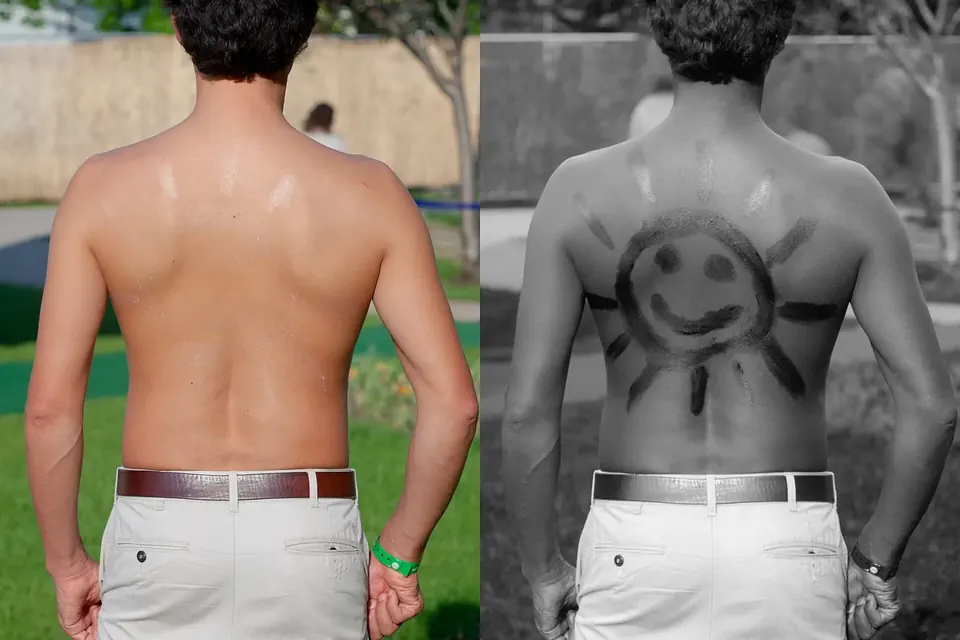
The photo at the top of this article shows why technique matters. Under ultraviolet light, skin covered with sunscreen looks dark and missed areas stay pale. The spots people forget most, according to the FDA, are the ears, nose, lips, back of the neck, hands, tops of the feet, along the hairline and any exposed scalp. For your own back, ask someone to help or use a spray – but, as the FDA warns, never spray it directly onto your face.
When to reapply
Both the FDA and the AAD say to reapply at least every two hours, and straight away after swimming, towelling off or sweating heavily, whatever the water-resistance claim. People who burn despite sunscreen, the AAD notes, usually did not reapply, used too little, or used an expired product.
The AAD also points out that skin is exposed to UV every time you go outside, including on cloudy days and in winter. The FDA advises limiting time in the sun between 10 a.m. and 2 p.m., when the rays are most intense, and treating sunscreen as one layer among several: shade, long sleeves, sunglasses and a broad-brimmed hat do a lot of the work.
Mineral, chemical, tinted
Sunscreen labels list "active ingredients", the substances that absorb or reflect UV rays. The FDA's list of commonly used actives includes the mineral filters zinc oxide and titanium dioxide and a range of organic ("chemical") filters such as avobenzone, homosalate, octisalate, octocrylene and oxybenzone. In June 2026 it added a new one, bemotrizinol. In September 2026 it removed two old ingredients, PABA and trolamine salicylate, from the list, while noting that it was not aware of any sunscreen on the market that still contained them.
The FDA also says there is evidence that at least some active ingredients are absorbed through the skin, and it has asked manufacturers for more safety data. Its advice in the meantime is clear: given the recognised benefits, keep using sunscreen along with other sun protection measures. If you prefer a mineral formula, or your skin reacts to a particular product, choosing by active ingredient is a reasonable way to narrow the shelf.
Tinted sunscreens containing iron oxide add something else. According to the AAD, iron oxide protects against visible light, which helps prevent dark spots.
Retinol, medicines and the pill: when sun protection matters more
Some products make skin react more strongly to sunlight, a side effect called photosensitivity. It can look like an exaggerated sunburn or a rash, sometimes within hours of going out.
The first group is in the bathroom cabinet. Retinoids can make skin more sensitive to the sun, which is why our guide to retinol for beginners recommends using them at night and a broad-spectrum sunscreen every morning. The FDA lists alpha-hydroxy acids (AHAs) in cosmetics, such as glycolic and lactic acid, among the triggers too.
The second group is prescriptions and everyday medicines. The FDA's list of medicines that can cause sun sensitivity includes:
- oral contraceptives and estrogens;
- some antibiotics, such as doxycycline and ciprofloxacin;
- common anti-inflammatory painkillers, such as ibuprofen and naproxen;
- some antihistamines and cholesterol-lowering statins;
- thiazide diuretics such as hydrochlorothiazide, often prescribed for blood pressure – see our article on high blood pressure in women;
- prescription oral retinoids such as isotretinoin.
Not everyone who takes these will react, and a reaction once does not guarantee another. But if you start a new medicine before a holiday or a summer of outdoor sport, it is worth asking the pharmacist whether sun sensitivity is on its leaflet.
Keeping it working: storage and expiry
- Check the date. FDA rules require an expiration date unless the product has been shown to stay stable for at least three years. A bottle with no date should be treated as expired three years after purchase; if you do not know how old it is, throw it away.
- Keep it out of the sun. Heat degrades sunscreen, which is why labels say to protect the container from excessive heat and direct sun. Wrap it in a towel or keep it in the shade of a beach bag.
- Mind the flame. Many spray sunscreens contain alcohol and are flammable. Do not apply or wear one near a barbecue, candles or a lit cigarette.
Babies and children
The FDA does not recommend sunscreen for babies under six months. Keep them out of the sun, particularly between 10 a.m. and 2 p.m., and use protective clothing if they must be outside; ask a doctor before using sunscreen on a baby that young. Older children can use sunscreen as directed on the label.
A quick checklist
- Broad spectrum, SPF 30 or higher, water resistant if you will sweat or swim.
- A shot glass for the body, a teaspoon for the face, 15 minutes before going out.
- Reapply every two hours and after swimming or sweating.
- Do not forget ears, neck, hands, feet and hairline.
- Add shade, a hat and sunglasses, especially around midday.
- Replace expired bottles, and ask about sun sensitivity when you start a new medicine.